The Pillow Dream at the Edinburgh Festival Fringe (2026):A Contemporary Yellow Millet Dream
Ming playwright Tang Xianzu adapted the Tang tale by Shen Jiji into The Handan Dream. The scholar Lu Sheng meets an immortal at an inn in Handan and dreams on a borrowed pillow. In the short time before a pot of yellow millet is cooked, he lives through fame, rank, and the rise and fall of a whole life. The traditional Chinese stage prefers to let the virtual stand for the real. It does not rely on built scenery. Time and space come from the actor’s body and from imagined action. That aesthetic fits a dream, because a dream breaks physical rules and moves like a shifting inner space. Jingkun Chinese Arts’ The Pillow Dream starts from this classical xieyi tradition. It tries to put the old dream in conversation with modern anxiety about identity and desire.
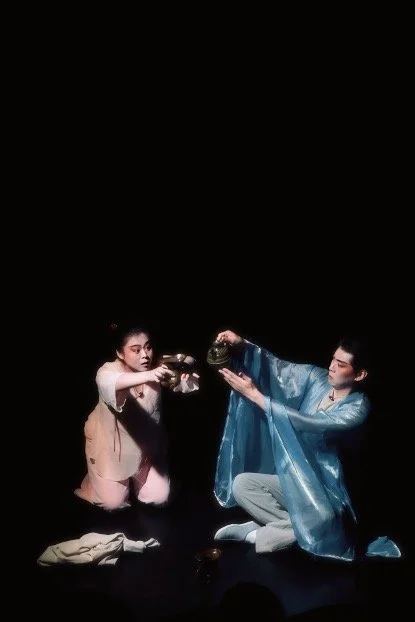
The production drops realistic sets. A few props and the bodies of two actors build the world. He Songyuan and Li Wanjin carry Lu Sheng through a lifetime. At the start he wears a short thin coat and walks alone through wind and snow with his arms folded. After he stops at the inn, the two sit facing each other, pour tea, and share a bowl of warm wine. A few lines and the act of drinking are enough to set a country inn. A mysterious pillow, a handkerchief, and a few light laughs send Lu Sheng into the dream. He leaps from a poor scholar to a new top graduate, then to a husband of a woman from the Cui family. The noise after success, the red thread in the wedding chamber, and the rise at court all come from changes of body and look in the eyes.
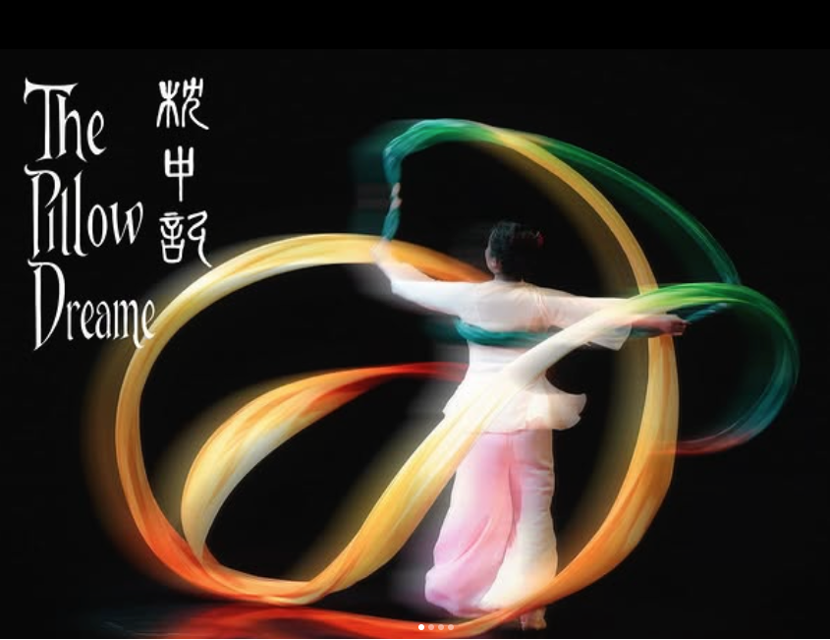
Sight and movement give this imagined space a sharp charge. On the small stage at C alto, Li Wanjin moves several long coloured silks. The silks pass over the body and draw unbroken arcs in the air. They recall the ribbons of the flying apsaras at Dunhuang. In the later climax, red and green strobe lights cut in at once and break the milder look of traditional opera. The two actors use solid martial technique for a tight fight. Bodies strike and water sleeves cross. War and the danger of court power become visible at once.
Beside the Kunqu singing, the waiter Xiao Er (Corey Lyu) gives this life of rank another reading. At scene changes he speaks English straight to us. He comments on each stage of Lu Sheng’s life in a rhythm close to stand-up. Lu Sheng is nearly thirty and still without official rank. He is summed up as “thirty, unemployed, and already questioning his life choices.” Then comes “So… basically, nothing unusual.” When Lu Sheng falls asleep, Xiao Er says, “Which, as we all know, is the fastest way to become successful.” Passing the exams means “he has a job.” Next, “apparently, now he needs a wife.” His tone is light and wry, as if he had already seen through the worldly game. He stands aside like someone who knows the pattern and will not spell it out too hard. He turns the old exams and titles into the job ladder and social pressure I already know. The old story suddenly feels close. When the court later sends Lu Sheng to the Hanlin Academy, he answers only, “That is not enough.” The drive of the dream of fame sits here. Each goal already reached quickly breeds a new desire.
The very abstract form also makes the show harder to follow. In the second half, war, power struggle, and sharp turns of life arrive in a rush. The coded action does not stay long enough in one situation. I sometimes could not tell at once where Lu Sheng was and what he faced. Huaying tells him, “You did not choose this road. It has already chosen you.” This should be the point where he stops chasing desire and is carried by the system. The stage stays too abstract and too fluid. It lacks a little grounding in a clear scene. The turn of fate feels hurried.
The ending brings the depth back. When the dream breaks, the waiter walks on with the millet that has just been cooked. Rank, war, love, and hate stop at once. Lu Sheng wakes and asks, “Should I go, or should I stay?” Lü Dongbin answers, “The road is always there.” The close does not turn into a simple lesson or into empty nothing. It shows a modern bind. Even when we understand the instability of work, identity and the systems of social value through which we measure ourselves, we still have to go on living within the world. Here the flowing form of Kunqu meets the play’s thought on the uncertainty of life. The old and the new speak to each other. The talk is flawed, but it is still worth thinking about.
★★★★★
Production Details
Production: The Pillow Dream
Company: Jingkun Chinese Arts
Director: Songyuan He
Venue: C alto, C venues, Edinburgh Festival Fringe
Date Viewed: 26 August 2026